The Crucial First Step: Why Journal Selection Matters for Your Career
As a medical professional, publishing your original research is a cornerstone of career advancement, knowledge dissemination, and establishing your credibility. However, merely publishing isn't enough; where you publish significantly impacts the reach, recognition, and long-term influence of your work. Choosing the right medical journal is a strategic decision that can elevate your research to the top, ensuring it resonates with the most relevant audience and contributes meaningfully to your field.
Understanding Your Manuscript's Core Value and Niche
What's Your Story? Define Your Research's Contribution
- Novelty and Significance: What makes your research unique? Does it introduce new findings, methodologies, or perspectives?
- Target Audience: Who stands to benefit most from your findings – specialists, general practitioners, policymakers, or a broader scientific community?
- Research Type: Is it a clinical trial, observational study, systematic review, case series, or methodological paper? Different journals specialize in different study designs.
Clearly defining these aspects will help you identify journals that align perfectly with your work's scope and potential impact.
Navigating Key Metrics: Beyond Just the Impact Factor
While often a primary consideration, the Impact Factor (IF) is just one piece of the puzzle. A holistic view of journal metrics is essential for strategic selection.
Impact Factor (IF): A Measure of Influence
The IF reflects the average number of citations received per paper published in that journal during the preceding two years. A high IF often indicates a journal's influence and visibility. However, consider its limitations:
- It can vary significantly between specialties.
- It doesn't reflect the quality of individual articles.
- It can be influenced by review articles or highly cited papers.
Beyond IF: CiteScore, SNIP, and SJR for a Broader Perspective
- CiteScore (Scopus): Similar to IF but calculated over three years and includes more document types. Offers a broader view of a journal's citation impact.
- Source Normalized Impact per Paper (SNIP): Measures contextual citation impact by weighting citations based on the total number of citations in a subject field. This helps compare journals across different disciplines.
- SCImago Journal Rank (SJR): Uses a sophisticated algorithm (similar to Google's PageRank) to weigh citations based on the prestige of the citing journal. A higher SJR indicates greater prestige.
Strategic Tip: Look for journals with consistently high scores across several metrics within your specific field. This indicates sustained quality and influence.
Acceptance Rate & Time to Publication: Balancing Ambition with Practicality
While prestigious journals often have lower acceptance rates and longer review times, they offer unparalleled visibility. Balance your ambition with practical timelines, especially if you have career milestones or grant deadlines.
Aligning with Journal Scope, Aims, and Audience
Is Your Research a Perfect Fit?
Thoroughly read a journal's "Aims and Scope" statement. Does your article directly address their stated objectives? Browse recent issues to see if similar research has been published. A mismatch in scope is a primary reason for desk rejections.
Who Reads This Journal? Reaching Your Intended Audience
Consider the journal's readership. Is it read by a niche group of specialists who will appreciate the nuances of your work, or a broader audience interested in general medical advances? Publishing in a journal with a highly relevant audience ensures your work reaches those who can best utilize and cite it.
Ensuring Quality and Ethical Standards
Rigorous Peer Review: The Hallmark of Credibility
A robust and transparent peer-review process is critical. It ensures the scientific validity, originality, and ethical conduct of published research. Journals with a strong reputation for rigorous peer review lend significant credibility to your work.
Publication Ethics and Transparency
Check if the journal adheres to guidelines from organizations like the Committee on Publication Ethics (COPE). Clear policies on authorship, conflicts of interest, data sharing, and research ethics are non-negotiable for reputable journals.
Indexing and Visibility: Maximizing Your Reach
Ensure the journal is indexed in major databases relevant to your field, such as:
- PubMed/MEDLINE: Essential for biomedical research.
- Scopus: Broad interdisciplinary database.
- Web of Science (Science Citation Index Expanded): Key for Impact Factor calculation.
- Embase, CINAHL, PsycINFO: Specialized databases relevant to specific fields.
Indexing guarantees discoverability, making your article accessible to a wider scientific community.
Practical Considerations for Authors
Open Access vs. Subscription Models
Consider whether an Open Access (OA) or subscription model best suits your needs. OA journals offer wider reach as articles are freely available, but often involve Article Processing Charges (APCs). Factor these costs into your decision, and check if your institution or funding body covers them.
Author Guidelines & Submission Process
Meticulously review the journal's author guidelines. Adherence to formatting, word limits, reference styles, and ethical declarations is crucial for a smooth submission process. A well-prepared manuscript reflects professionalism and respect for the journal's standards.
Avoiding Predatory Journals: A Critical Warning
In your quest for publication, beware of predatory journals. These exploit the "publish or perish" culture by charging APCs without providing legitimate editorial and peer-review services. Red flags include:
- Aggressive email solicitations.
- Vague or non-existent peer review.
- Fake impact factors or misleading metrics.
- Poor website quality and grammatical errors.
- Lack of clear editorial board or contact information.
Always verify a journal's legitimacy through reputable databases and resources like DOAJ (Directory of Open Access Journals) or by consulting your mentors.
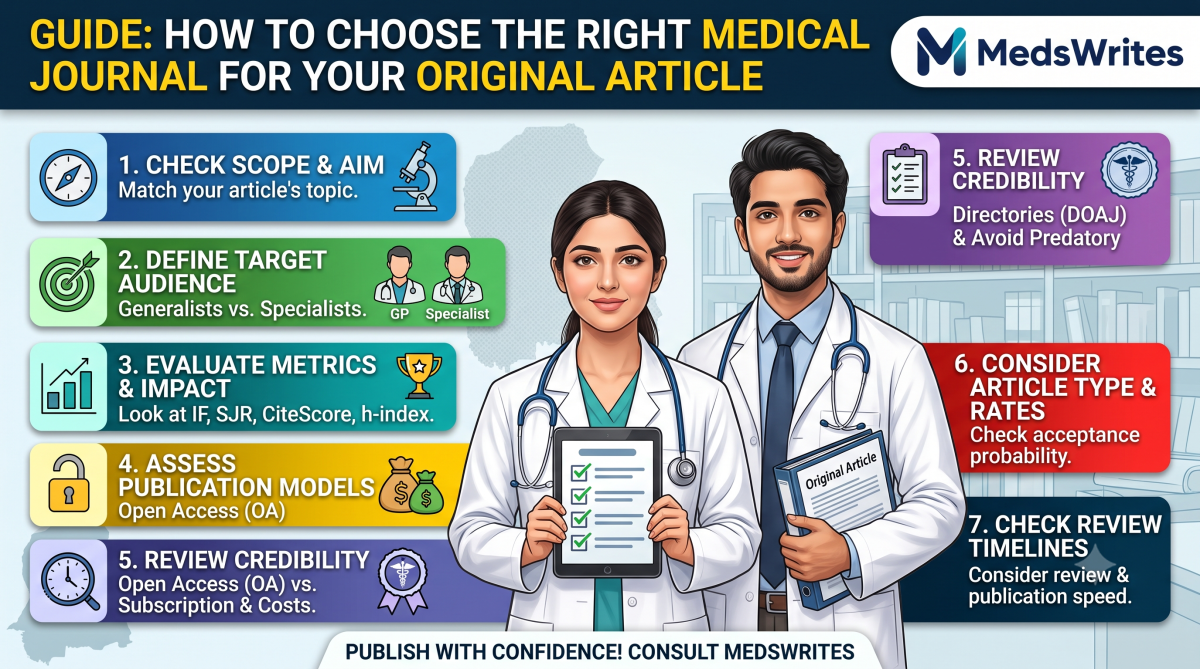
Your Strategic Journal Selection Checklist
To ensure you choose a journal that elevates your research to the top, follow this systematic approach:
- Define Your Research's Niche: Understand its novelty, scope, and target audience.
- Create a Shortlist: Based on your research and preliminary searches (e.g., using journal finders like Elsevier Journal Finder, Springer Journal Suggester).
- Evaluate Metrics: Compare IF, CiteScore, SNIP, and SJR within your field.
- Assess Scope & Audience Alignment: Read "Aims and Scope" and recent articles.
- Verify Quality & Ethics: Check for robust peer review, ethical policies, and COPE membership.
- Confirm Indexing & Visibility: Ensure presence in key databases.
- Consider Practicalities: Review APCs, acceptance rates, and time to publication.
- Consult Mentors & Colleagues: Leverage their experience and insights.
- Review Author Guidelines: Prepare your manuscript meticulously according to their requirements.
Conclusion: Maximizing Your Research's Impact and Your Professional Standing
Choosing the right medical journal is a critical strategic decision that can significantly amplify your research's impact and your professional standing. By thoroughly evaluating a journal's scope, metrics, ethical standards, and audience, you can ensure your original article reaches the most relevant readers, contributes meaningfully to medical science, and solidifies your reputation as a leading expert in your field. Invest the time in this crucial step, and watch your research soar to the top.